
'To sustain our growth trajectory, we must continue to explore and capitalise on growth opportunities.'

Corporate India is starting to step up its capital expenditure plans amid government incentives and signs of rising demand, company executives and analysts have indicated. This coincides with the Reserve Bank of India (RBI) recently citing a double-digit growth in private capital expenditure. Healthy balance sheets of banks and corporates, along with increasing capacity utilisation and improving business sentiment, are contributing to a favourable environment for sustained growth in private sector investments, the RBI said in its policy last week.

Russia's war on Ukraine has sent steel prices soaring to its highest levels in the domestic market since November 2021. But there is little cheer in the industry. That's because input costs are spiralling out of control, leaving the big boys nearly as high and dry as the small, medium and secondary steel producers. Russia and Ukraine are major providers of steel and raw materials to the world.

From the Sensex pack, IndusInd Bank, NTPC, Asian Paints, Hindustan Unilever, JSW Steel, Tech Mahindra, Bajaj Finance, Infosys, Wipro, ICICI Bank, Bajaj Finserv, HDFC Bank and Tata Motors were among the major laggards. HCL Technologies, Power Grid, Titan, Reliance Industries, UltraTech Cement, Tata Steel, State Bank of India and Mahindra & Mahindra were the gainers.

Tata Sons chairman Natarajan Chandrasekaran was paid Rs. 113 crore as remuneration for 2022-23 (FY23), including Rs. 100 crore as commission on profit. Chandrasekaran, 60, often referred to as Chandra, received a remuneration of Rs. 109 crore in 2021-22 (FY22). With this, Chandra has emerged as one of the highest-paid chief executive officers (CEO) in Corporate India for FY23.
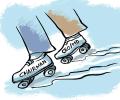
Mirroring the increase in the earnings of their companies, the chief executives and promoters of India's top listed firms gained handsomely from the boom last financial year. Their remuneration includes salaries, perquisites or perks, and profit-linked commissions.
Operating margins have been the primary driver of corporate earnings in India in recent quarters, despite revenue growth suffering from weak consumer demand. Companies across sectors have reported a sharp improvement in earnings before interest, tax, depreciation, and amortisation (Ebitda) margins over the past two years, benefiting from lower commodity and energy prices. Higher margins more than compensated for slower revenue growth, resulting in double-digit growth in net profit for five consecutive quarters.

Domestic stock markets would be driven by inflation numbers, global trends, and the last batch of Q4 earnings this week, analysts said. Markets will also react to industrial production data and consumer inflation numbers that were released after market hours on Friday. "Participants will react to macroeconomic data viz. IIP and CPI first, which were released post-market hours on Friday.

"Lady candidates need not apply." So read the postscript in a job notice from Telco (now Tata Motors) on a notice board in the corridors of the Indian Institute of Science, Bangalore (now Bengaluru), in 1974. Irked, Sudha Murty, who was then pursuing her masters in computer science at the institute, wrote a postcard to JRD Tata, expressing her surprise at this gender discrimination, especially since the Tata Group were pioneers on many fronts. Shortly, Murty became the first woman on the firm's shop floor.

Two O P Jindal group companies, JSW Steel and JSL Stainless, have entered into an agreement. JSL Stainless will produce coke for JSW Steel and the raw material to produce coke will be supplied by JSW.JSW Steel is promoted by Sajjan Jindal. His brother, Ratan Jindal, is managing director of JSL Stainless.
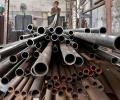
Worried by a spike in Chinese imports, the Indian Steel Association (ISA) plans to take up the matter with the government and seek measures to fix "trade distortions". Alok Sahay, secretary general of the group that represents the country's steel producers, said systemic changes were needed. "In order to take any trade measure, it takes a minimum of 15 months' time, due to prevalence of lesser duty rule in India, making India an easy target. "We are going to write to the government on this," he said.

With Housing Development Finance Corporation's (HDFC's) merger with HDFC Bank becoming effective on July 1, the merged entity is set to become the top weight in the benchmarks S&P BSE Sensex and the National Stock Exchange Nifty indices, dislodging the country's most valuable company, Reliance Industries (RIL), from its perch. HDFC will stop trading after July 13. At present, RIL has a weighting of close to 12 per cent in the Sensex and 10.3 per cent in the broad-based Nifty. Meanwhile, HDFC Bank and HDFC have weights of 9.9 per cent and 6.8 per cent in the Sensex and 8.8 per cent and 6 per cent in the Nifty, respectively.
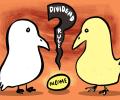
Hindustan Zinc (HZL), a subsidiary of Vedanta, announced an interim dividend of Rs 21 per share last week, resulting in an outflow of Rs 8,863 crore. The announcement has turned the spotlight on India Inc's dividend-paying policy - more so for reasons driving the generosity of firms. An analysis of BSE 500 companies by Business Standard Research Bureau shows that some of the top 20 dividend-paying companies in 2021-22 (FY22) include Vedanta, Tata Consultancy Services, HZL, Oil and Natural Gas Corporation (ONGC), Indian Oil Corporation (IndianOil), Hindustan Unilever (HUL), Reliance Industries (RIL), and Bajaj Auto, among others.

Even as the slowdown in the information technology (IT) services sector deepens, banking, financial services and insurance (BFSI), as well as oil and gas companies, emerge as the primary drivers of corporate earnings in the country. The IT services sector's share in corporate earnings declined to a five-year low of 17.4 per cent in the second quarter (Q2) of 2023-24 (FY24), whereas banks and finance companies accounted for 46.5 per cent, and oil and gas firms contributed 16.8 per cent. At their peak, IT services firms like Tata Consultancy Services (TCS), Infosys, HCLTech, and Wipro represented just over a third of the combined net profit of all listed companies in the Business Standard sample.

Metal and mining companies, such as Tata Steel, JSW Steel, Hindalco, and Coal India, have been among the top-performing sectors on the bourses in recent months. The S&P BSE Metal Index is up 13 per cent in the past three months, rallying 29 per cent in the past year, outperforming the broader market. For comparison, the benchmark S&P BSE Sensex has only seen a 1.7 per cent increase in the past three months, with a 15 per cent gain since the end of September last year.

The Q1FY24 earnings season has started on a dismal note for corporate India. The early-bird companies' revenue growth has been at a 10-quarter low, while the combined earnings of non-BFSI (banking, financial services, and insurance) companies seem to have hit the ceiling. The numbers suggest corporate India is entirely dependent on BFSI companies and the IT services sector to drive growth in revenue and profit while other sectors are showing signs of stagnation.

Top companies have grabbed a bigger pie of their sectors in the pandemic period, leading to a further rise in market concentration in many industries as measured by the Herfindahl-Hirschman Index (HHI). The HHI score, which indicates competitive intensity in an industry (or a lack of it), reached a new high in FY21 as bigger firms raised their revenue market shares either organically or through mergers and acquisitions. A higher HHI score indicates a rise in market concentration in favour of a few firms while a lower score means that the industry's revenue is more evenly divided among many companies
Governance group SES thinks so but JSW Steel says he's exemplary and deserves it.
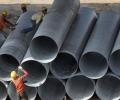
The festive season will mean business for the steel industry as it is the time when automotive and consumer appliance companies bump up demand to prepare for higher sales, experts have said. Ranjan Dhar, chief marketing officer at ArcelorMittal Nippon Steel India (AM/NS India), said that bookings by auto and consumer appliance industries are 20 per cent higher ahead of the festive season compared to last year. "While this could be for a couple of months, it could normalise later at approximately 10 per cent," he said.

Tata Consultancy Services (TCS), the group's biggest cash generator, overtook Vedanta to become the highest dividend payer in India in FY23. The IT services major paid Rs 42,090 crore for FY23, up 167.4 per cent from Rs 15,738 crore for FY22. The 10 biggest payers together shelled out Rs 2.06 trillion for FY23, more than double the Rs 98,371 crore for FY22.
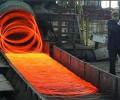
Despite NMDC raising iron ore prices by 10%, major steel firms say they will follow suit if demand increases
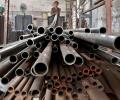
Given wild swings, investors are wondering where the metal market is going. There was a strong uptrend in industrial metal through much of the last three years due to fears of supply chain issues - first due to Covid-19 and then due to the Ukraine War. That uptrend broke down as it became apparent that global growth would moderate as inflation rose and Western Europe (the EU plus the UK) went into a near-recession and China was in a rolling lockdown.

Over the weekend, many companies stepped in to ease the bottleneck in supply and transportation of oxygen, as demand ran high with the surge in cases.
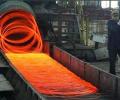
Last Friday, the Supreme Court in a ruling allowed auction of 1.5 million tonne of iron ore a month.

Earlier this month, the high court asked Sesa Goa and JSW Steel to re-bid.

Vinod takes centrestage as Pramod stays away from deal; uncertainty over the latter's continuity on Ispat board.

The stock market's momentum will be guided by the ongoing quarterly earnings season, with Reliance Industries, HUL and Bajaj Finance among those scheduled to announce their results this week, analysts said. Focus would also remain on the COVID situation, global stock markets, investment pattern of foreign institutional investors (FIIs), rupee-dollar trend and Brent crude, they added. "The earnings season would gain pace this week and participants will be closely eyeing the results of some of the top names like Reliance, Ultratech Cement, Bajaj Auto, JSW Steel, Bajaj Finance, Asian Paints, Hindustan Unilever among others. "Before that, markets will first react to the earnings of two heavyweights -- HCL Technologies and HDFC Bank in early trade on Monday," said Ajit Mishra, VP Research, Religare Broking.

The domestic benchmark indices - the S&P BSE Sensex and the National Stock Exchange Nifty50 - had lost close to 1.5 per cent in three days recently before gaining slightly. Notwithstanding weakness and volatility, the Nifty50 has managed to hold on to the 18,000 mark, while the Sensex has managed to stay above the 61,000 level. The performance of the stocks that comprise these front-line indices remains polarised.

JSW Steel is learnt to have submitted its resolution plan along with AION Capital

Though the ruling Left Front in West Bengal recorded its worst performance in the recent Lok Sabha polls, industrialists appear to be unperturbed by the changing political wind in the state and believe industrialisation will continue.

Notwithstanding expectations of a pick-up in construction activity during a seasonally strong January-March quarter (fourth quarter) of 2022-23 (FY23), analysts are cautiously optimistic about the building material sector - encompassing paints, pipes, wood panels, tiles, metals, and cement - as volatile input costs, coupled with fears of a global slowdown, are making demand projections uncertain. Against this backdrop, analysts suggest investors stay selective and pick stocks of companies with stronger brand recall, expanding distribution network, diversified product profile, healthier balance sheet, and sustainable cash flow. "The government's various proposals under Budget 2023-24 (FY24) may lead to the building material segment growing between 8 per cent and 12 per cent for the next five years.
At least three steel companies-JSW Steel, Jindal Stainless and Bhushan Steel-have decided to wait for the financial storm to pass before they take up their expansion plans. Ministry may not achieve target to cross 100 MT output by 2012.

Many CEOs said they plan to give special leave to women employees so as to encourage their participation in the workforce.
Lines up investments in steel, power sectors to profit from booming demand.
Jindal Steel has acquired mining rights in Chile for $52 million.
Steel prices have come down by around 40 per cent since July this year. At present, prices of hot-rolled coil are ruling at Rs 30,000-32,000 a tonne. Ispat Industries director (finance) Anil Sureka said ex-factory prices of hot rolled coils were even lower.

Management buyout vehicle Excalibur Steel, Sanjeev Gupta's Liberty House metals group, India's JSW Steel Ltd and Greybull Capital have submitted separate bids
At a time when instability in the US leveraged buyout (LBO) market is making world equities markets jittery, JSW Steel is planning a leveraged buyout of a North American steel company.

Salboni, in West Medinipur district, is where JSW Steel in 2007 said it would be putting up a 10 million tonne a year steel factory, plus a big captive power plant.

Quarterly earnings and global cues will be the major sentiment driver for the equity market this week, according to analysts. Of late, Benchmark indices have been on a record-breaking run. "Quarterly results will dictate market sentiment and will be the talk of this week as they pick up the pace. "D-Street will be all ears to any management insights to forecast the future earnings trajectory.
